
Do you suffer from neck or back pain after a long day at work? If so, you are not alone. According to US News and World Report, approximately 1 in 10 people across the world suffer from chronic lower back and/or neck pain. Recent studies have shown that lower back pain is responsible for about one third of work-related disability and has been the cause of more debility than approximately 300 other health conditions worldwide.
Posture and the Spine
Curves are a normal part of the spine’s structure. Looking at the spine from a lateral view, the spine resembles a soft ‘S’ shape. A healthy back has three natural curves: a slight forward curve in the neck (cervical lordosis curve), a slight backward curve in the upper back (thoracic kyphosis curve), and a slight forward curve in the low back (lumbar lordosis curve). Good posture actually means keeping these three curves in balanced alignment. Long periods of sitting, especially in a slumped or slouched position, can alter those curves and increase strain to the body. Strong and flexible muscles also are essential to good posture. Abdominal, hip, and leg muscles that are weak and/or inflexible cannot support your back’s natural curves.
 A common condition contributing to neck pain is forward head posture. Forward head posture occurs when the neck protrudes forward placing the head in front of the shoulders. The continuous forward pull of the head over taxes muscles of the upper back and puts excessive strain on the vertebrae. This position is often accompanied by rounding of the upper back and shoulders.
Poor posture plays a large role in many cases concerning lower back pain. Prolonged periods spent in a slouched position causes atrophy of the abdominal muscles and increased strain to the stabilizing ligaments in your lower back, creating a spine that is vulnerable to injury. Furthermore, this position promotes the shortening and tightening of the hip flexor (psoas) muscles which alters the distribution of forces on the spine, increasing the risk for herniated discs in your lower back.
The term “ergonomics” is derived from the Greek words: “ergon,” meaning work, and “nomoi,” meaning natural laws. Ergonomics is the science that deals with designing and arranging things so that people can use them easily and safely.
When we sit, we are at our most vulnerable for developing poor posture. An improper workspace setup can promote poor posture which can lead to an array of repetitive strain injuries to the body. Sitting with poor posture is a bad habit that can be avoided with proper ergonomics and self-awareness. You can maintain proper posture while sitting by:
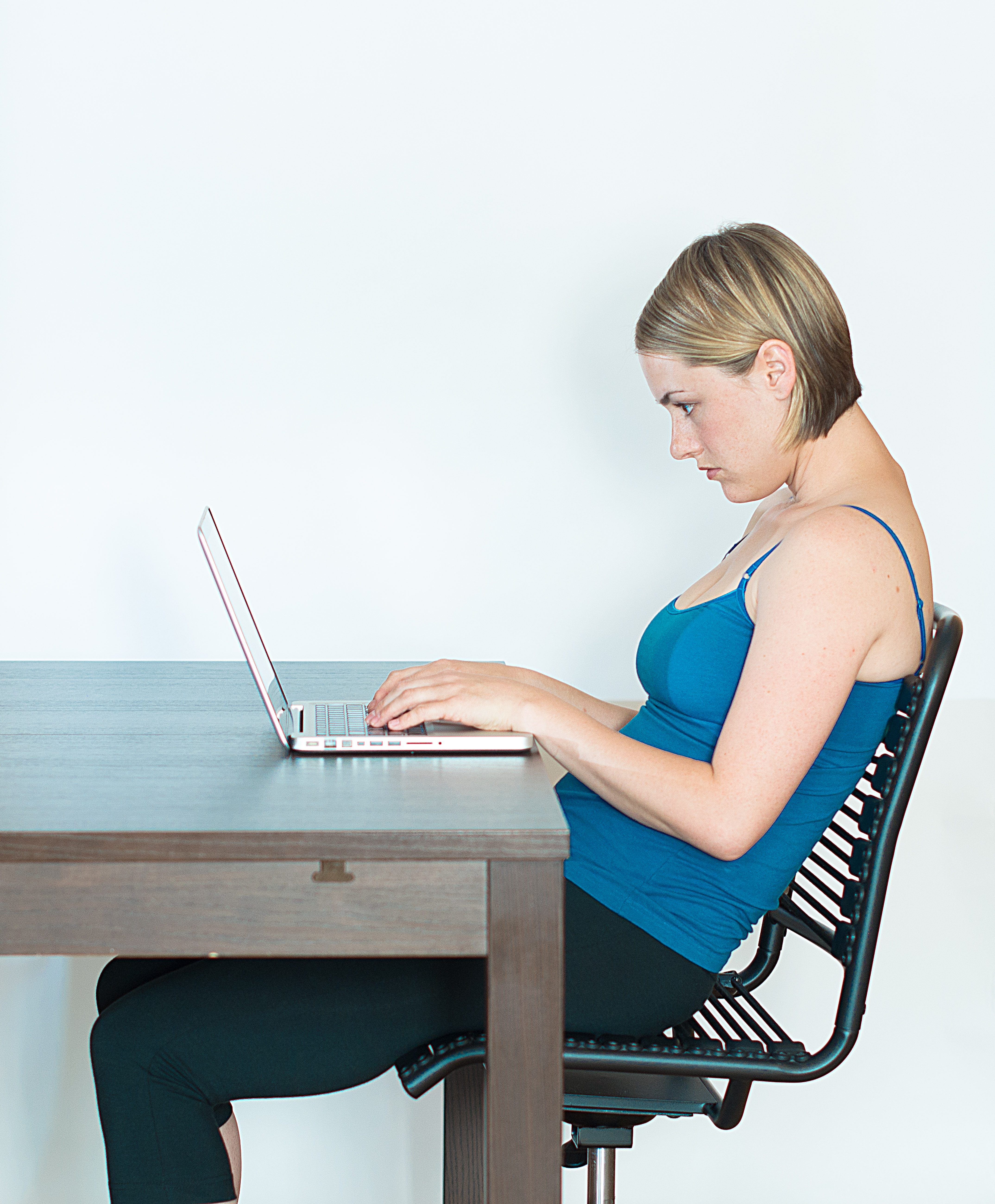
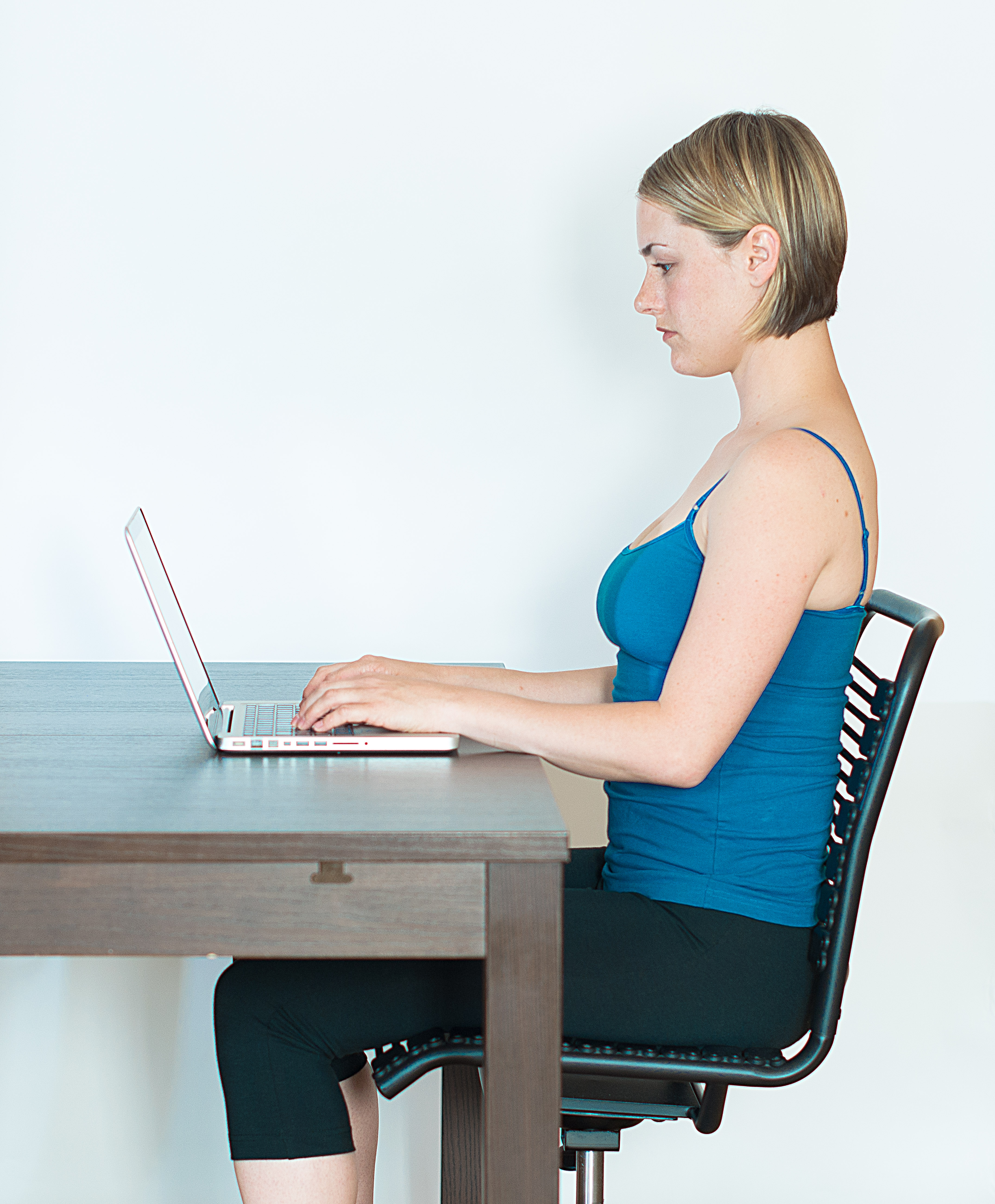
POOR POSTURE———————- CORRECTED POSTURE
Choose the right chair
- The right chair can make all the difference, especially if it’s a chair where you will sit for long periods of time. Make sure your chair adequately supports your back and allows you to place both feet on the floor.
- Sit on an unsteady surface such as an exercise ball to reinforce activity in your core muscles.
Proper positioning
- Keep your feet flat on the floor, slightly apart. Your knees should be bent at a right angle and should be even with, or slightly higher than, your hips.
- Make sure your weight is distributed evenly on both hips. Do not sit biased to one side.
- Keep elbows at your sides with slightly more than 90 degrees bend.
- Keyboard should be at the same height as your elbow with wrists slightly bent.
- Mouse should be adjacent to and at the same height as your keyboard.
- Eyes should be level with the top 1/3 of your computer screen.
Take regular breaks
- If you’re getting neck and back pain from sitting at your desk, alternate between sitting and standing at your work station. If possible stand up throughout the day and/or take walks every 30-60 minutes.
- Avoid staying in one position for long periods of time; inactivity causes muscle tension and weakness.
Reminders
- Set an hourly alarm to remind yourself to check your posture.
- Have a friend or coworker check your ergonomic setup by taking a photograph of you sitting at your desk.
Assistive Tools
- When reading, use a document holder to prevent repetitive strain of the neck.
- Use a headset when using the phone.
- Utilize a small pillow or lumbar roll between the back of your chair and the small of your back, keeping your lower back properly aligned to reduce strain.
A physical therapist can evaluate your posture and develop a corrective exercise program. After a complete evaluation, a physical therapist can help you identify your particular postural and musculoskeletal problems. At that time you will be provided a personalized treatment plan and specific home exercises to correct them. A physical therapist will also be able to provide an ergonomic assessment of your workstation.Premier Physical Therapy is available for individual ergonomic assessment or corporate ergonomic services.
In good health,
Peter Patumaranan, DPT
References:
http://www.merriam-webster.com/dictionary/ergonomics
http://apps.washingtonpost.com/g/page/national/the-health-hazards-of-sitting/750/
Join the conversation