
Warmer weather is finally here and with it brings a new season of recreational and serious cyclists to the open road. I sometimes get questions about proper bike fit, so here are the general “tips” or “rules” that go along with fitting yourself on a road bike. Like all sports, fitting yourself for a bike can vary depending on what bike you’re using, so always ask a trusted physical therapist, or get fitted at a bike shop that knows what they’re doing!
Stand Over Height
When choosing a bike, you should be able to stand over the top tube with at least 1” of space with a straight tube, and 2” or more with a tube that slopes towards the back of the bike. You can test this by standing over the top tube and lifting the bike up to meet your body. There should be at least 1” space from the tire to the ground. Mountain bike riders sometimes have 3-5” clearance due to the extra demands of the landscape. Stand over height is important should you need to dismount quickly, and is the first step in sizing your bike. If your stand over height is not good, all the other measurements will not be 100% accurate.
Seat Height
The height of the seat will determine the amount of knee extension you have, and even affect the stability of your pelvic floor. Having a seat that is too high can diminish the power your legs can make, leading to exces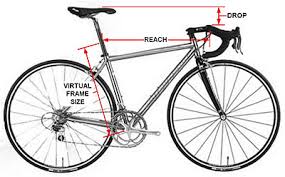 s stress on the muscles on the back of your leg. You may have too high a seat height if you’re rocking side to side on your saddle, which can cause undue stress on the glutes, spine, even your arms! Having a seat that is too low will increase the amount of knee bend, which increases the pressure on the knee cap. It also doesn’t allow the glutes/calves/hamstrings to work as efficiently as they should.
You can determine proper seat height (on a road bike) using the” Le Mond Method.” Measure your inseam (without shoes) and multiply that by 0.88 to get your seat height. Then measure from the base of the crank arm up along the seat tube to the top of the saddle, adjusting the saddle up or down to match that number.
Seat Fore/Aft Position (forward/backward)
The distance the seat or saddle is from the handle bar is known as seat fore/aft position. Too far forward can increase knee cap pressure, too far backward can over lengthen the glutes/hamstrings, making them less efficient during a pedal stroke.To measure proper seat fore/aft position, have someone hold the bike still for you and get on. With the crank arm (the lever that holds the pedal to the front gear/derailleur) parallel to the ground, the area right below your knee cap should align with the ball of your foot on the pedal. Cyclists who have poor hip mobility will need to be more forward/fore with their saddle. Your physical therapist can work on improving your hip mobility. Larger cyclists may be more comfortable more aft (backward) with their saddle.
Saddle Angle/Seat Inclination (tilt)
It is recommended that the tilt be kept at 0 degrees, though there is one study that demonstrated that a tilt forward of 10-15 degrees decreased the incidence of LBP in recreational cyclists.
Reach
This is basically how far your arms have to reach to touch the handlebars. This varies with rider and bike, however ideally a rider on a road bike without aerobars would want the back to not arch, pelvis to be rolled forward, have retracted shoulder blades, unlocked elbows, and relaxed upper arms with the elbows slightly bent.
Crank
This is the part of the bike that connects the pedal to the front derailleur. This is commonly overlooked on bikes, as most recreational bikes have a standard 170mm length. Shorter bicyclists (under 5 foot 6 inches) should have cranks less than 170mm as longer cranks can cause increased pressure on the knee and can result in knee pain. Riders shorter than 5 foot 3 inches should have a crank size between 167.5 and 165mm. Riders who are greater than 6 feet in height should have a crank that is around 177.5mm. It appears that riders who are average in height (5’7”-6’) do not need to worry about crank size.
Cleats
For those road bike warriors who use cleats, there are numerous brands, types and fits. Generally the idea is to have enough “float” or movement, to allow the cleat to detach from the pedal if needed (e.g. to get off the bike in a hurry) without too much excessive movement when pedaling, which is known as “slop.” Cleats transfer the force of your legs to the pedal/crank. Cleats should have a “low stack height,” which basically means the closer the cleat can come to the pedal the better, almost as if your foot and the pedal were one unit. A properly sized cleat “has a midpoint that the foot will sit at most of the time, with a small amount of force required to move off that midpoint.” The base of your metatarsals (the long bones of the foot just before the toes begin) should align with the axis of rotation of the pedal.
Enjoy the ride!
Vito Pinto, DPT
References:
Brukner, P., Khan, K., Bahr, R., Blair, S., & Cook, J. (2012). Clinical Sports Medicine (4th ed.,pp. 93-112). Sydney, Australia: The McGraw-Hill Companies.
Salai M, Brosh T, Blankstein A et al. Effect of changing saddle angle on incidence of low back pain in recreational bicyclists.
Join the conversation